·14 min read·Biotech industry
Made in China: The Therapeutic Version
Why China's drug-development engine is accelerating, and what its clinical trials, incentives and regulatory reforms could teach the United States.
In 1747, during a particularly grueling ten week patrol, a naval surgeon called James Lind decided to try out different daily treatments. He split a group of twelve sailors, all with identical symptoms of bleeding gums and fatigue, into six pairs. One group receiving oranges and a lemon made a dramatic and full recovery. It is generally regarded as the first controlled clinical trial, the earliest attempt to test a medical intervention against comparators.
Since then, the system that discovers and tests a new medicine has become one of the most elaborate enterprises constructed. The clinical trial sits at its center, but around it has grown a dense architecture of preclinical requirements, regulatory filings, manufacturing validation, and multi-year approval timelines. The whole apparatus exists for good reason: the thalidomide disaster, and the subsequent Kefauver-Harris Amendment of 1962, required drug manufacturers to prove a drug was not only safe but effective. That framework has been refined and expanded over six decades, but in the last year, there has been a great push for clinical trial reform, spearheaded mostly by a fear or admiration at the rate of therapeutic innovation in China. But faster trials are not the only issue, there is a need for faster discovery and faster translation from molecule to practice.
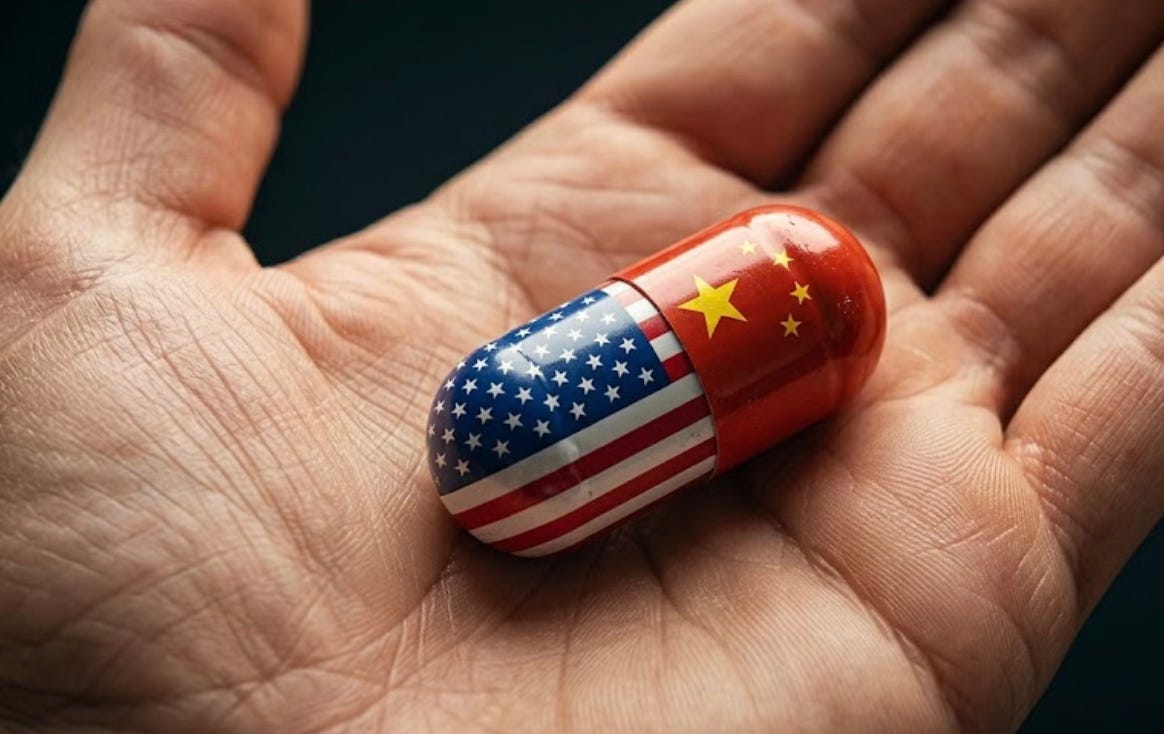
Made in China.
At this year’s ASCO, the presentations that generated the most discussion were largely Chinese-developed therapeutics.
Bob Duggan, the biotech veteran who led Pharmacyclics to a $21 billion AbbVie acquisition, presented data from his new company Summit Therapeutics. After taking it over in 2020, Duggan and his co-CEO Maky Zanganeh hired a handful of former Pharmacyclics employees and gave them a single brief: find a cancer drug anywhere in the world. It was Fong Clow, a Pharmacyclics veteran, who suggested looking in her home country, China. In mid-2022, the team zeroed in on ivonescimab, a PD-1/VEGF bispecific already in Phase III trials at Hong Kong-listed Akeso. Michelle Xia, Akeso's founder, had earned a PhD in molecular biology in the UK and worked at Bayer before returning to China to build her own company.
She and Zanganeh connected quickly, and in December 2022, the two companies agreed to a $500 million upfront license with $4.5 billion in milestone payments. Duggan and Zanganeh had to borrow to cover the upfront sum.
But ivonescimab also illustrates the tension at the heart of China-generated data. The Harmoni-6 trial that earned a plenary slot at ASCO, the first China-developed asset to do so in the conference's six-decade history, enrolled 532 patients exclusively in China.
The headline was a median overall survival difference of 4.2 months, the first time any regimen has beaten PD-1 plus chemotherapy in 1L Squamous NSCLC.
But there are specific concerns, the trial excluded patients older than 75 when in the West the median age of lung cancer diagnosis is closer to 70.
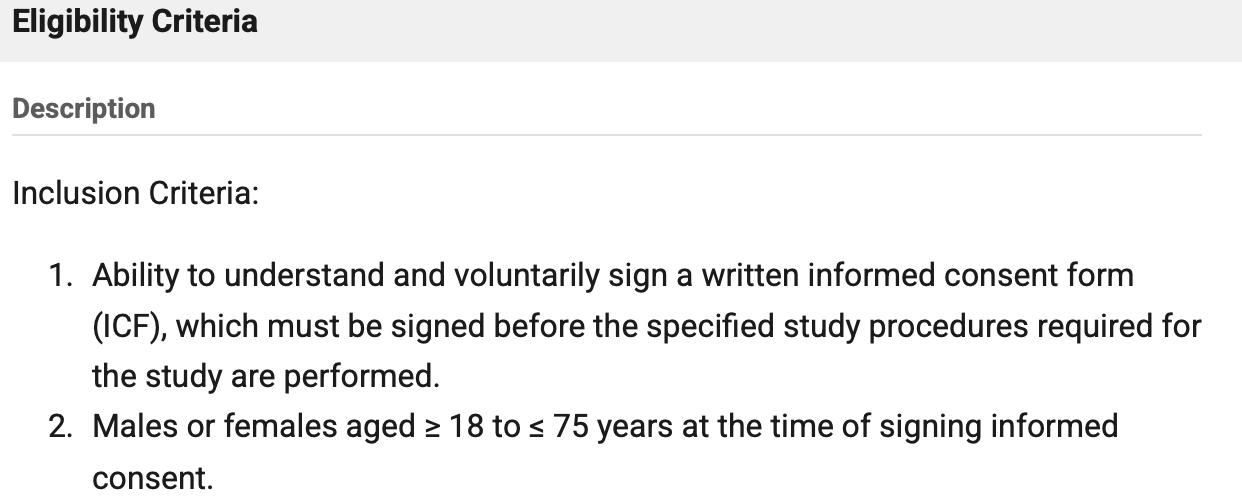
That being said it is standard to exclude patients over the age of 75 years in China and hopefully there will be a global phase III study to cover this. The subgroup over the age of 65 did not show any benefit (HR 0.93) on analysis (whether this reflects a genuine lack of efficacy in older patients or an underpowered subgroup is still an open question).
There were only 10 women enrolled in the ivonescimab arm and 28 in the control arm. The events were so few (5 in the ivonescimab arm) that a hazard ratio could not even be reported. For a drug heading toward a global BLA, the standard expectation for squamous NSCLC trials is at least 20% female enrollment.
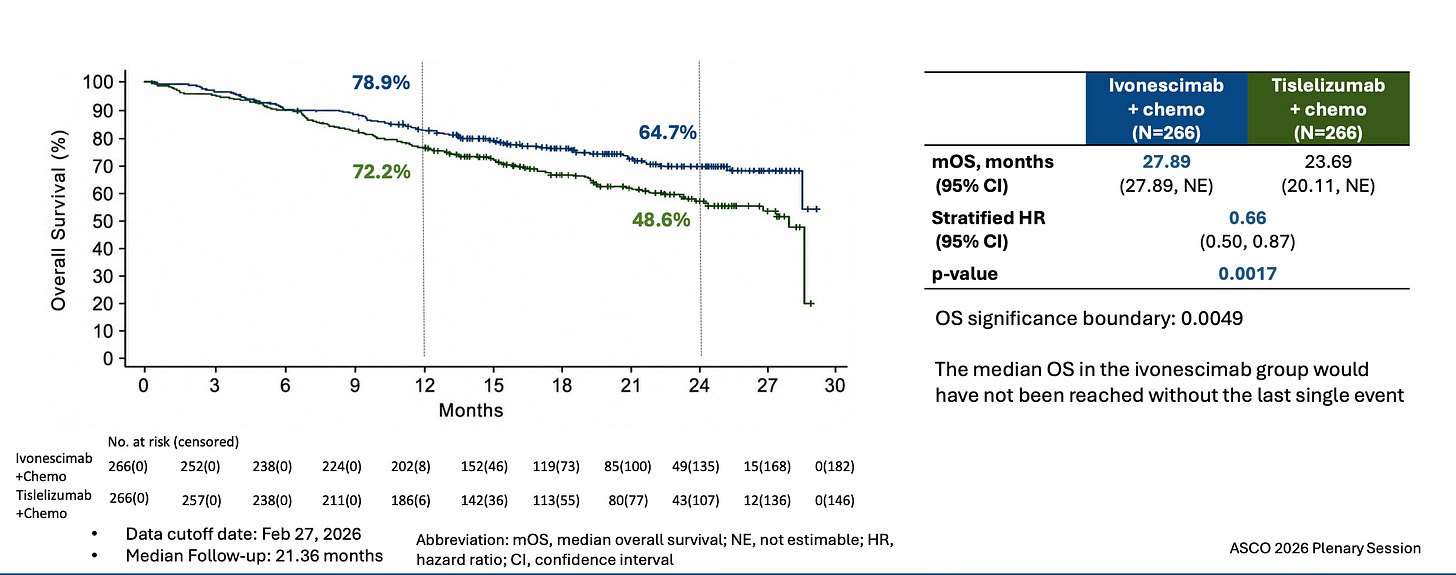
The overall survival curves show separation that widens over time, but the data is very immature (median follow-up is 21.4 months) and thus we cannot conclude much about the tail and without a doubt this must be validated in a global study.
None of this means ivonescimab doesn't work. It means the data generated in China doesn't automatically answer the questions the FDA, and Western oncologists, will ask. That gap between a Chinese Phase III readout and a global BLA is the central challenge of the most important trend in drug development right now. Roughly half of all major licensing deals struck so far this year involve drugs originating from China. A decade ago, that share was nearly zero.
Understanding how this happened requires going back four decades.
Reform by Design.
In 1986, Deng Xiaoping (China’s then paramount leader) approved the 863 Program which designated biotech alongside I.T. and space as strategic research priorities for China. For years after, China was a generics and active pharmaceutical ingredient powerhouse, but novel drug innovation was rare. The biotech ecosystem lacked commercial infrastructure, regulatory sophistication and the depth of scientific talent of the West.
That began to change in 2008, when China launched the Thousand Talents Plan, which recruited over 7,000 overseas scientists within a decade. Among the returnees were researchers who would go on to found companies that now rank among the country's most important drug developers, including BeiGene (now BeOne Medicines).
The decisive regulatory shift came in 2015 when the State Council issued "Opinions on Reforming the Review and Approval Process for Drugs and Medical Devices" a document that initiated significant pharmaceutical regulatory reform in China.
At the time, the CFDA (the China Food and Drug Administration, the country’s equivalent of the FDA) had only 120 employees responsible for technical review, and processing of 8,000 applications per year. The system was overwhelmed, and the quality of clinical trial data was considered unreliable.
Reform was led by a man called Bi Jingquan. His first priority was data integrity: the 722 Notice required companies to self-examine the authenticity of their clinical trial data. Nearly 80% were voluntarily withdrawn.
But the reforms also created new flexibility. A marketing authorization holder system decoupled drug licenses from manufacturing, allowing researchers and small companies to hold approvals without building their own factories.
In 2018, the CFDA was restructured into the NMPA and introduced the tacit approval mechanism for IND applications. If the regulator did not object to an IND within 60 days, a trial could proceed. The timeline collapsed from a median of 265 days to roughly 50.
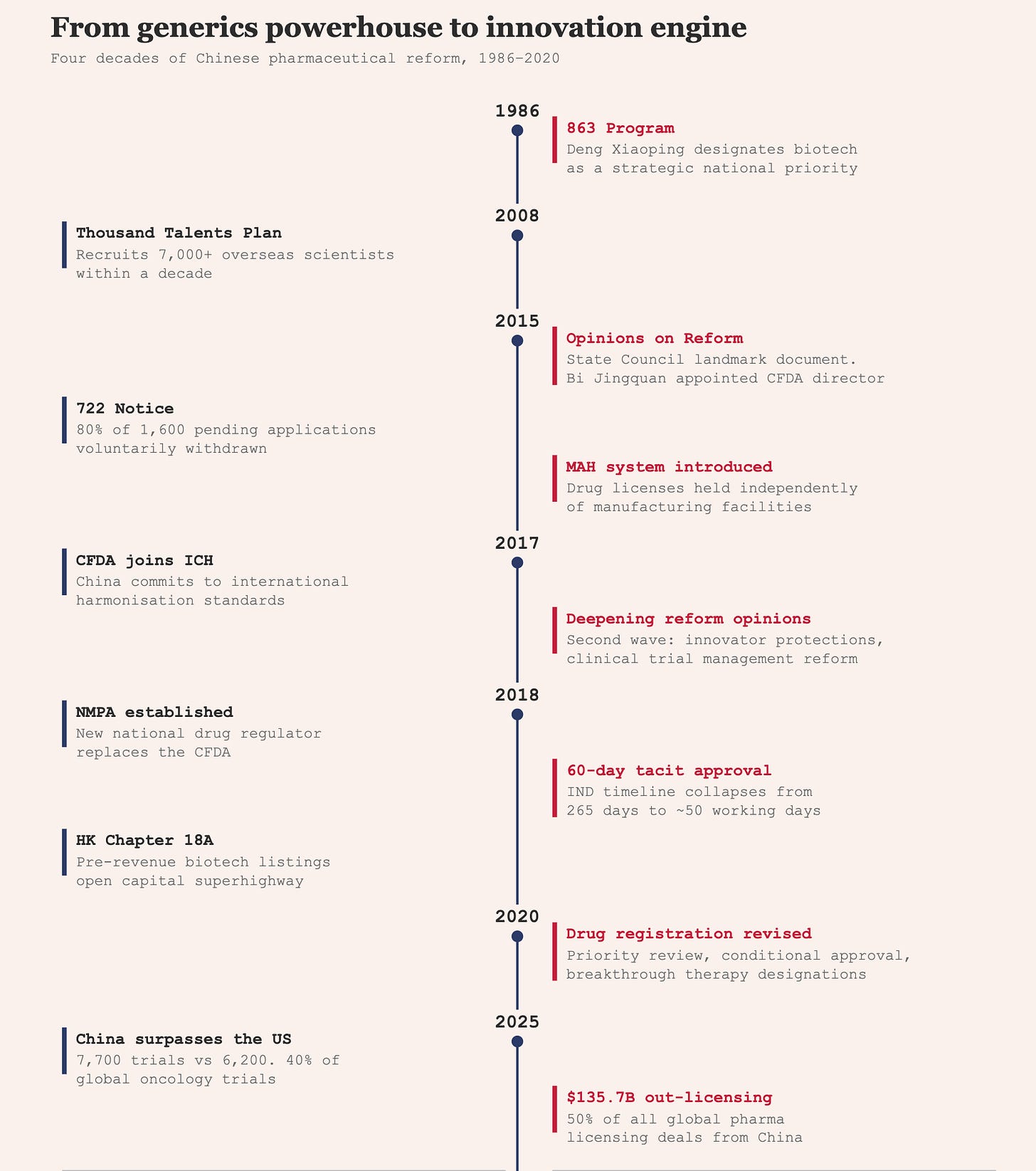
Capital followed the reform. The Hong Kong Stock Exchange introduced Chapter 18A, allowing pre-revenue biotech companies to go public. Shanghai's STAR Market soon followed, transforming the scale of Chinese biotech investment (over ¥418.4 billion in primary market financing). Investment peaked in 2021 with ¥103.4 billion raised across 811 financing events.
The majority of capital was directed toward small-molecule drugs (34%), cell therapies at 21%, and therapeutic vaccines at 12%, and this pipeline is increasingly flowing outward. In 2024, antibody-based candidates accounted for 37% of out-licensing deals, including 18 ADC-related transactions.
Jiangsu Hengrui, once a generics manufacturer, now has over 100 innovative products in clinical development and more than 400 ongoing trials globally. Last July, GSK paid $500 million upfront for access to up to 12 Hengrui programs. Hengrui leads development through Phase 1 and GSK takes the global option afterward.
BeOne Medicines, formerly BeiGene, has gone far too. Founded in 2010 by John Oyler and Xiaodong Wang, it has grown into a global company with 11,000 employees. Its flagship BTK inhibitor, Brukinsa, cleared $3.9 billion in global sales in 2025 and is now the revenue leader of the entire BTK class, having taken the top spot in new US CLL patient starts away from AbbVie's Imbruvica.
The Learning Loop.
The clinical mechanism that underpins much of China’s speed advantage is the investigator-initiated trial (IIT) especially in oncology.
In most Western countries, any study involving an experimental drug in humans requires formal approval from a national regulator. In the US, this means filing an Investigational New Drug (IND) application (which includes preclinical pharmacology, manufacturing documentation and a detailed clinical protocol). The IND ensures that a drug has been adequately characterized before it reaches patients, but it is also slow and expensive.
In China an IIT is run by a medically qualified investigator at a hospital or research institution. It is approved by the institution’s own ethics committee and governed by the National Health Commission (not the NMPA). Thus any medically qualified investigator at a major hospital can design a protocol, secure local ethics approval, and begin enrolling patients. IITs are most heavily concentrated in oncology and cell and gene therapy, but have also been used in autoimmune disease and rare disease.
When the cycle from new construct to patient data takes months rather than years, a company can run three or four optimization cycles in the time a US competitor completes one.
Jacob Becraft, CEO of Strand Therapeutics, described the dynamic as a “flywheel effect”: early clinical data sets off a self-reinforcing cycle: positive human results attract capital, capital funds partnerships and manufacturing, and the resulting infrastructure makes subsequent trials faster and cheaper. The country where that cycle takes root will capture not just the data but the entire ecosystem that grows around it.
Some are embracing this, like Alex Zhavoronkov, the CEO of Insilico Medicine, who moved his R&D to China. His company has nominated more than 22 preclinical candidates since 2021, 10 of which have reached clinical stage. The first, an AI-discovered molecule for idiopathic pulmonary fibrosis, completed Phase IIa.
The American Friction Tax
By contrast the American pathway is measured in years where China’s and Australia’s are in months.
In June, HHS released Operation TrialBlazer, a roadmap for maintaining US leadership in early clinical research. Before an IND is even filed, the average gap between requesting a pre-IND meeting and submitting runs up to 380 days, with some stretching to nearly 700 days. The IND itself clears in 30 days, comparable to China. But then other requirements like institutional review board (IRB) approval, contract negotiation and site activation, can add up to 13 additional months before a single patient is dosed.
China commits to dosing their first patient within twelve weeks of submission. Thus it seems less surprising that China starts roughly 4x as many Phase 1 trials as the United States, and no system that gates studies behind a monthly volunteer committee (IRB) meeting can match that cadence.
The FDA has begun to respond, though the question is whether the response matches the scale of the problem. New Approach Methodologies, AI-powered models, organ-on-a-chip systems, in silico simulations, are being positioned as replacements for the time-consuming animal testing that historically dominated pre-IND requirements.
But under every version of the streamlined pathway, the architecture is unchanged: a sponsor files an IND, the FDA reviews it, an IRB clears it, and only then does a patient receive a dose. China's IIT route removes that centralized gate for whole classes of cutting-edge therapy and lets a funded investigator begin.
The Cost of Speed.
And then there is LungTIME, a reminder that China’s speed advantage carries its own risks. In February, a paper in Nature Medicine reported that NSCLC patients who received PD-1 inhibitor plus chemotherapy before 3 PM experienced a 60% reduction in the risk of progression or death. By June, Nature had retracted the study entirely. There were many issues with the study. The protocol was dated January 2022 but referenced papers published in 2023 and 2024. The PFS curves were suspiciously smooth and there was zero censoring in the first year not to mention 0% rate of adverse events led discontinuation.
LungTIME does not invalidate Chinese innovation. But it exposes a real systemic gap: uneven quality control across thousands of hospitals and inconsistent ethical review. This is not a problem unique to China, but it does require consideration.
The Case for Staying.
The current response of sponsors is to run Phase I in China. There is a counterargument to this, and until recently it had a credible voice inside the FDA. Vijay Kumar, the previous acting director of the FDA’s Office of Therapeutic Products argued that sponsors pursuing first-in-human studies outside the US may find the time saved counterproductive overall. By going to China, he argues that sponsors will miss the modernization underway at the FDA: the Commissioner’s National Priority Voucher program, which has reviewed zongertinib in 44 days. The plausible mechanism framework. Animal-testing alternatives. CMC flexibilities for cell and gene therapy. A single-pivotal-trial policy and real-time clinical trials.
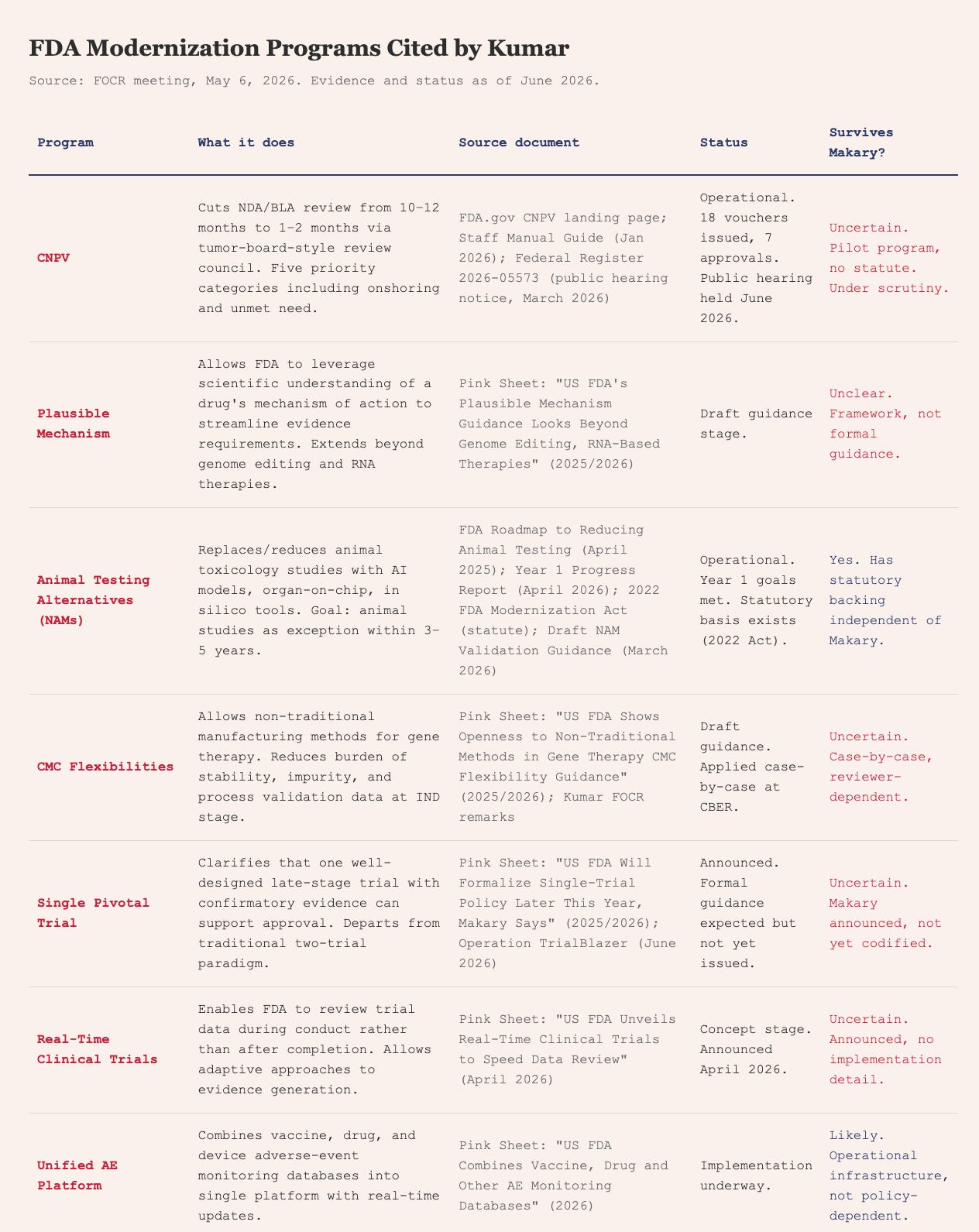
He also listed concerns about overseas first-in-human studies: manufacturing chain integrity, facility inspectability, the informed consent process, and the applicability of data generated entirely in Chinese patients to the US population.
The main concern now is that the two officials, Vinay Kumar and Marty Makary, who most visibly carried the modernization message have both since left.
The Inflow.
The Western biotech world is tapping into China rapidly and at scale. Bristol Myers Squibb signed a $15.2 billion deal with Hengrui. AstraZeneca partnered with CSPC Pharmaceutical for an obesity portfolio worth up to $18.5 billion. Pfizer, AbbVie and Eli Lilly the list extends across every major Western pharma company. For the first time in history, more drugs made their market debut in China than in any other country in 2025.
“I go to bed and wake up with in my mind there are two things: China and AI,” Pfizer CEO Albert Bourla said.
When the post-2021 biotech bubble burst, the venture capital that had funded early-stage discovery in the United States dried up. Lean startups could no longer afford to run high-risk programs. The current playbook emerged from this necessity.In-license a best-in-class, clinically de-risked asset from China, install experienced Western executives, raise an oversubscribed round, and fund the program through Phase 2 on US soil: the NewCo structure
The most vivid illustration of this model is Kailera Therapeutics, which in April broke the all-time record for the largest biotech IPO in history, raising $625 million on the strength of a pipeline licensed entirely from China. But some deals also involve co-development and co-commercialization terms like the Pfizer-Innovent pact and Bristol Myers Squibb’s Hengrui deal.
The dependency runs deepest in the modalities that matter most. In ADCs, Chinese biotechs now account for nearly 90% of all global licensing activity. In protein degraders, up to a third of ASCO presentations now feature Chinese data. What makes this particularly striking is how recently China was a pharmaceutical afterthought. For decades, the country’s role in the global drug supply chain was confined to generics manufacturing and active pharmaceutical ingredient production.
The rare-earth and EV analogies are deployed constantly in these debates: we handed solar panels to China and batteries to China and lost those industries. If we hand drug discovery to China, we will lose that industry too.
But pharmaceuticals are not solar panels. A drug is a treatment for a human being who is sick and thus the question is more complicated. There is no legitimate argument for denying patients access to the best available medicine because the molecule was discovered in China rather than Cambridge.
Bruce Booth at Atlas Ventures calls China’s rise “more opportunity than threat” and “a healthy forcing function to raise the game for everyone.” The question is now whether the infrastructure we built to discover and test medicines can be rebuilt fast enough to stay in the game.
Booth is right that China’s rise is more opportunity than threat, and right that it should function as a forcing mechanism. The harder question is what the US does with its own system, because the infrastructure has accumulated procedural drag that no amount of cross-border collaboration will fix on its own.
China’s advantage is often distilled to cheaper trials and faster approvals, but really they have built a system that learns faster. IITs feed real-world clinical observations back into next-generation protocols at a pace the US does not match.
Centralized hospital networks function as standing trial infrastructure oppose to the US version of having sites that need to be recruited and spun up for every program.
The goal for the FDA is not to lower the bar: an FDA approval means something to patients, physicians and payers. Instead reforms should attack latency at different points in the evidence-generation pipeline. New approach methods compress the dead time before first-in-human studies. Single pivotal trials eliminate redundant evidence generation where one well-designed study can be definitive. Real-time clinical data and plausible mechanism guidance avoid decision timelines of years. The FDA should not just judge evidence. It should help produce it faster.
Read next